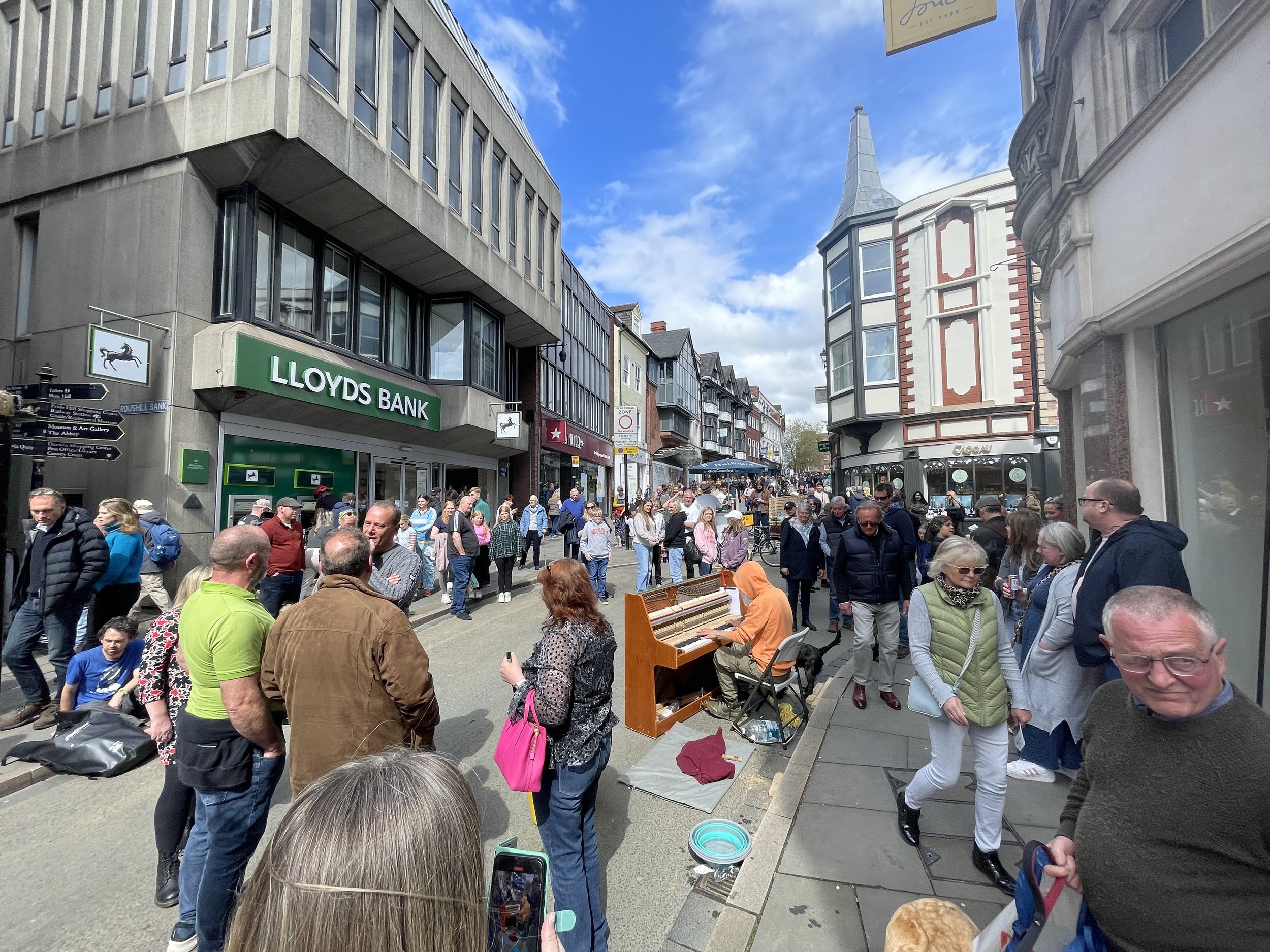
James Tofalli is a self-taught pianist who found music at the moment he needed it most. In the early days of his recovery from addiction, he was drawn to the public pianos at Saint Pancras Station. With his hoodie pulled up, he played only for himself — not to be seen. The piano wasn’t about performance; it was about feeling alive when everything else felt broken.
In time, people began to stop and listen. What started as a private lifeline slowly grew into something larger: a way of reaching others without words, offering to them the same hope the piano had given him.
Before music, James spent his days in the kitchens of London, working long hours in a life that felt far removed from who he was becoming. In 2017, he walked away from it, choosing instead to make his living through music. Busking became not just a way to survive, but a way to live with purpose.
For several years James busked the streets of London with electronic keyboards and amplifiers learning what it meant to make a living from music. The city gave him an audience, but it never gave him the connection he was searching for. Eventually, he left London behind — and with it the keyboards too.
Today, James lives on the road, travelling the UK with his four dogs and an upright piano, playing in a different town or market almost every day. It’s a life few would imagine for themselves — waking in a van, pushing a 150-kilogram instrument onto the high street — but for James, it is fulfilling. Each performance is a chance to relive the lifeline he found in music and to share it with others. For James, it has never been about money, but about the moments of connection only a piano on the street can create.
Why the Street Matters
For James, busking is more than performance — it’s tradition, community, and honesty. Street music has always been about immediacy: no stage, no ticket, no barrier. Just music offered freely to whoever passes by.
James prefers the simple sound of coins hitting the bucket. “Every coin means someone stopped, listened, and felt something. When I count them at the end of the day, I know each one represents a person I’ve reached.”
Busking, to him, is proof that music belongs everywhere — not only in concert halls, but in markets, side streets, and town squares. It’s a reminder that art isn’t just for those who seek it out; sometimes it finds you when you least expect it.
That’s why his mantra, Don’t Judge – Just Listen, carries so much weight. Behind the piano isn’t a stage persona or a polished act, but a man offering honesty through music. For James, keeping music alive on the streets isn’t just about his own path; it’s about reminding us all that connection begins when we set aside judgment and simply listen.